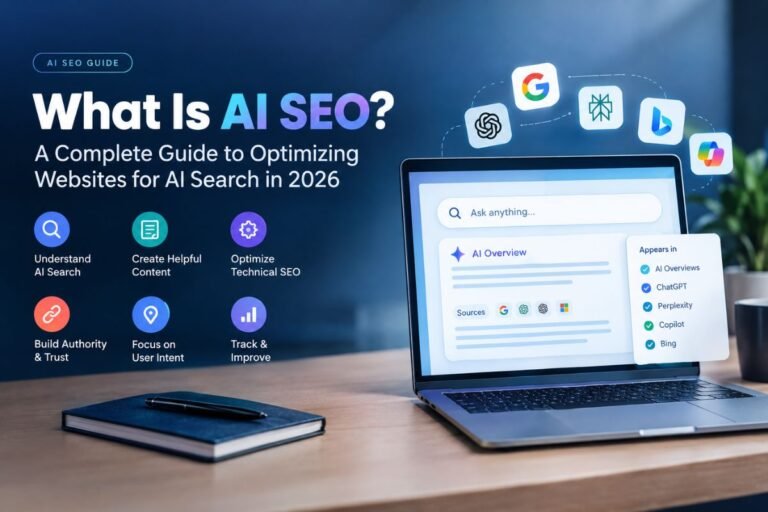
How to Optimize Your Website for Google AI Overviews and AI Mode in 2026
If you’ve been checking Search Console more often than usual this year, you’re not imagining things. Impressions are up in a lot of accounts, clicks are flat or down in the same accounts, and a chunk of your queries now trigger something other than ten blue links. That something is an AI-generated summary sitting above the results, or increasingly, a full conversational search experience that keeps going after the first answer.
Ranking well in the traditional sense still matters. But it’s no longer the whole story of whether your site shows up when someone searches. Google now folds a lot of Search traffic through two AI-powered layers: AI Overviews, the summary panel that appears directly on the results page, and AI Mode, the more conversational, exploratory search experience. In May 2026, Google announced it’s merging the two into a single, seamless AI Search experience, which means the line between “getting a quick AI summary” and “having a back-and-forth AI conversation” is dissolving rather than staying as two separate systems to optimize for.
This article walks through what AI Overviews and AI Mode actually are, what’s changed and what hasn’t in how visibility works, and what you can practically do this month to improve your chances of showing up and getting cited. I’ll flag clearly where something is confirmed by Google and where it’s an SEO industry observation, because a lot of the AI-SEO content floating around blurs that line, and that’s part of what’s made this topic feel more confusing than it needs to be.
What Are Google AI Overviews?
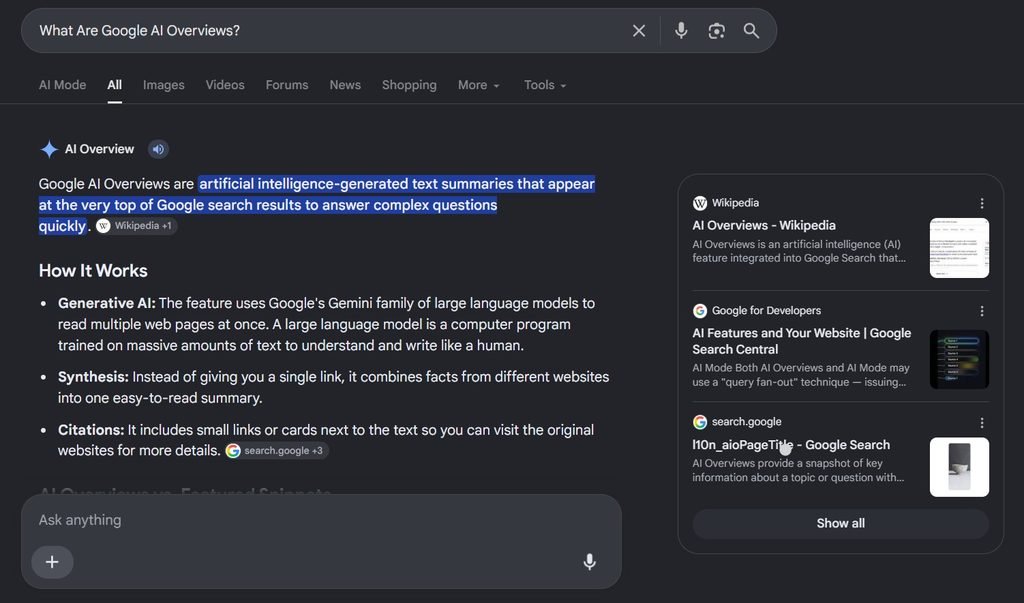
AI Overviews are the AI-generated summary blocks that appear on the Google Search results page for certain queries, usually sitting near the top, above or alongside the traditional organic listings. According to Google’s own documentation, AI Overviews are designed to help people get to the gist of a complicated topic or question more quickly, and to give them a jumping off point to explore links to learn more.
They don’t show up for every search. Google generates them when its systems determine a synthesized answer would genuinely help, typically on more complex or multi-part questions rather than simple navigational ones (“what’s the Nike return policy” behaves differently than “Nike”). The overview itself is generated using retrieval-augmented generation, sometimes called grounding, which Google describes as a technique used to improve the quality, accuracy, and freshness of AI responses by pulling from Google’s Search index rather than relying purely on a model’s internal training.
Source links are typically included within or alongside the summary, and clicking through works the same way a normal search result link does. What this means practically for publishers is that appearing in an AI Overview isn’t a replacement for ranking organically, it’s closer to an additional surface layered on top of the same index. If your page isn’t crawlable, indexable, and reasonably well-optimized for the query already, it has very little chance of being pulled into the summary in the first place.
What Is Google AI Mode?
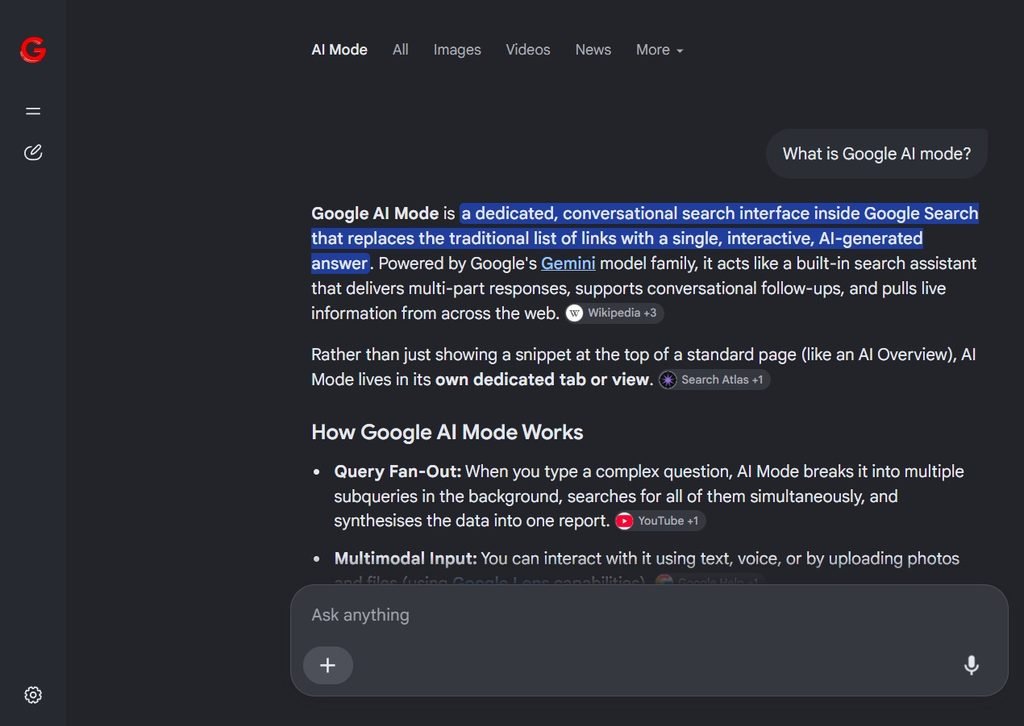
AI Mode is a more fully conversational search experience. Instead of returning a static page of results (with or without a summary), it lets someone ask a question, get a synthesized response with supporting links, then ask a follow-up that stays in context, similar to chatting with an AI assistant that happens to be grounded in live web results.
The practical difference from a normal search is that AI Mode is built for the kind of query where one search used to turn into three or four. Comparing two SaaS tools, planning a multi-city trip, researching a medical condition before a doctor’s appointment; these are the queries Google specifically points to when describing AI Mode’s purpose, noting it’s particularly useful for questions that involve further exploration, reasoning, or complex comparisons.
Both AI Overviews and AI Mode can use what Google calls a “query fan-out” technique, where the system issues multiple related searches across subtopics and data sources to build out a fuller answer rather than working from a single query. That’s a meaningful shift for how you should think about content coverage. A page that answers a narrow question well can still miss out if it doesn’t also cover the two or three related sub-questions the system is fanning out to check.
At Google I/O in May 2026, Google announced it’s merging AI Overviews and AI Mode into a single seamless AI Search experience, with a redesigned search box that accepts text, images, files, video, and open Chrome tabs, and that carries context as someone moves from an overview into a deeper conversational follow-up. Google also said AI Mode had passed 1 billion monthly users at that point, with query volume more than doubling every quarter since launch. That merge is rolling out gradually rather than instantly, so for now it’s still useful to think about the two surfaces separately, even as the practical distinction fades.
AI Overviews vs AI Mode: What’s the Difference?
| AI Overviews | AI Mode | |
|---|---|---|
| What it is | AI-generated summary embedded in the standard results page | Dedicated conversational AI search experience |
| Search experience | Appears above or alongside organic results for qualifying queries | Full-screen, chat-style interaction, increasingly reachable from the search box |
| Query behavior | Triggered by complex or multi-part questions, not every search | Built for exploratory, comparative, multi-step research |
| Follow-up questions | Limited; can hand off into AI Mode | Native; context carries across turns |
| Content discovery | Draws from Google’s index using query fan-out | Same index, broader fan-out across more subtopics |
| Role of website links | Source links shown within or near the summary | Source links attached throughout the conversation |
| SEO implications | Reward pages that already rank well and answer the query directly | Reward sites with broader topical coverage across related questions |
Don’t over-read this table. Both surfaces are drawing from the same underlying index and the same core ranking systems. The differences are in experience and query behavior, not in some separate “AI Mode ranking algorithm” that requires a different playbook from scratch.
Does Traditional SEO Still Matter for AI Search?
Yes, and this is one of the few points where Google has been unusually direct. In its official guide to optimizing for generative AI features, published on Google Search Central in May 2026, Google states plainly that best practices for SEO remain relevant because these features are rooted in its core Search ranking and quality systems. Its companion documentation, “AI Features and Your Website,” goes further, stating there are no additional requirements to appear in AI Overviews or AI Mode, nor other special optimizations necessary, beyond reviewing the fundamentals you’d already want in place.
That doesn’t mean nothing has changed. What’s changing is emphasis, not the rulebook. Crawlability and indexability still come first, because a page that Google can’t reliably access can’t be cited by anything, AI-powered or not. Helpful, people-first content still matters, arguably more, because when a system is choosing what to synthesize into a summary, thin or derivative content gives it nothing distinct to pull from. Site architecture, internal linking, and topical depth matter because query fan-out means your site is being evaluated across a cluster of related questions, not just the one someone typed.
What’s genuinely new is the framing SEOs have started using around “non-commodity content,” meaning content that offers something a dozen other sites haven’t already said in nearly identical words. That’s not an official Google term, but it’s a fair professional interpretation of what Google is pointing at when it emphasizes originality and depth over generic coverage.
How to Optimize Your Website for Google AI Overviews and AI Mode
1. Start With Strong Technical SEO
None of this works if Google can’t crawl and index your pages reliably. That means your robots.txt isn’t accidentally blocking important sections, your XML sitemap is current and only includes canonical, indexable URLs, and your canonical tags point search engines to the correct version of a page rather than creating conflicting signals. Check for stray 4xx and 5xx errors on important pages, and if your site relies on JavaScript to render core content, confirm that content is actually visible in a rendered fetch, not just in the raw HTML.
Mobile usability and Core Web Vitals are part of page experience, and page experience is part of the broader quality picture Google evaluates. But be careful with the causation here: a fast, mobile-friendly page does not directly guarantee AI Overview visibility. It removes friction that could otherwise hold a decent page back. Treat it as table stakes, not a lever you pull to “unlock” AI citations.
Duplicate content and messy site architecture create the same problem for AI systems that they’ve always created for traditional ranking: it’s harder for search engines to figure out which version of a page or which section of your site should be treated as the authoritative one.
2. Create Content That Directly Answers Search Intent
Search intent hasn’t changed, but the cost of missing it has gone up. If someone searches for a specific question, don’t make them read four paragraphs of background before you get to the answer. Lead with the direct answer, then build out the supporting context, examples, and nuance underneath it.
This applies whether the query is simple (“what is a canonical tag”) or complex (“how do canonical tags interact with hreflang on a multilingual ecommerce site”). In both cases, the page should demonstrate it actually understands and covers the topic, not just that it contains the right keywords. Add real examples, walk through the reasoning, and where relevant, show what happens when the advice is applied rather than just stating it.
3. Make Important Information Easy to Understand
Clear headings that describe what’s actually in that section, short paragraphs, and descriptive subheadings all help a human skim your page and help a machine parse it into digestible chunks. Use lists where you’re genuinely listing discrete items, and use tables when you’re comparing things across the same attributes, the same way this document does above.
None of this is a guarantee of inclusion in an AI Overview. Structure helps comprehension; it doesn’t override thin or inaccurate content. Think of formatting as removing obstacles, not as a checklist that earns you a citation on its own.
4. Build Topical Depth Instead of Publishing Random Articles
If your site is built around “SEO” as a subject, a single comprehensive article won’t carry the topic on its own. You’d typically want supporting content around technical SEO, on-page optimization, keyword research, internal linking, content optimization, local SEO, ecommerce SEO, ongoing SEO audits, and now, AI search optimization itself. Each piece should link to the others where it’s genuinely relevant, so the cluster reads as a coherent body of knowledge rather than a pile of disconnected posts targeting slightly different keywords.
This matters more under query fan-out. If Google’s system is checking three or four related subtopics to build an answer, a site with genuine depth across that cluster has more surface area to be pulled from than a site with one strong article and nothing around it.
5. Strengthen Internal Linking
Contextual internal links, placed naturally within the body of a page rather than crammed into a “related posts” widget, help both users and search engines understand how your content connects. Use descriptive anchor text (“how to fix crawl errors,” not “click here”), and consider a hub-and-spoke structure where a central pillar page links out to detailed subtopic pages, which link back to the pillar and sideways to each other where relevant.
Your most important pages should be easy to reach through internal links, not buried three or four clicks deep with no clear path leading to them.
6. Demonstrate First-Hand Experience and Expertise
This is where a lot of AI-generated content falls flat, and it’s also the area where a real practitioner has a genuine advantage. Original examples, screenshots from your own testing, first-hand observations about what actually happened when you tried something, and transparent methodology all signal that a real person did the work behind the content.
Concretely, this can mean showing a before-and-after of a page you actually optimized, describing what you tested and what the result was, or noting where your recommendation is a professional judgment call rather than a settled fact. It’s the difference between writing “internal linking helps SEO” and writing “when we restructured internal links on a client’s blog around three hub pages, the previously orphaned articles started getting indexed again within a few weeks.” Don’t invent the second kind of detail if it didn’t happen, but if it did, that specificity is worth including.
7. Strengthen Your Website’s Entity and Brand Signals
Keep your business name, address, and other identifying details consistent across your website, Google Business Profile, and other platforms where you’re listed. Maintain a real About page that explains who runs the site and why they’re qualified to write about the subject, and attach clear author information to content, particularly on YMYL-adjacent topics like health and finance.
Being mentioned by other reputable sites in your space, cited in industry roundups, or referenced in third-party coverage all contribute to a broader reputation signal. Google hasn’t published a specific formula for how entity signals factor into AI features, so treat this as reasonable professional interpretation built on Google’s long-standing E-E-A-T guidance, not as a confirmed AI-specific ranking mechanism.
8. Use Structured Data Correctly
Structured data, using schema.org vocabulary, helps search engines understand what a page is about in machine-readable terms. For most content sites, Article, FAQPage (used only where a page genuinely contains FAQ content), Organization, and Author/Person schema are the relevant types. For ecommerce, Product and Review schema help clarify pricing, availability, and rating data.
The structured data on a page needs to accurately reflect the visible content. Marking up FAQ content that doesn’t actually appear on the page, or exaggerating ratings in schema that don’t match what’s shown to users, is the kind of mismatch Google’s guidelines have long discouraged. Adding schema is not a documented shortcut to AI Overview inclusion. It’s a clarity tool, not a visibility hack.
9. Optimize Content for Complex and Conversational Queries
Someone might start with “best CRM for a small agency,” then follow up with “does it integrate with QuickBooks,” then “what’s the actual cost after the free trial.” A single page that only answers the first question misses the rest of that conversation. Comprehensive content that naturally covers the adjacent questions a reader would logically ask next, integrations, pricing beyond the headline number, common limitations, gives both human readers and AI systems more to work with in one place.
You don’t need to guess every possible follow-up. Start from the two or three questions your own customers or readers actually ask after the first one, and build those into the page.
10. Support Important Claims With Reliable Sources
When you make a factual claim, especially a statistic, a specific number, or a claim about how something works, back it with a primary source: official documentation, original research, or a clearly identified expert source. This is different from just scattering outbound links for the sake of having them. A citation should support a specific claim in the sentence it sits next to, not just gesture vaguely at “further reading.”
11. Keep Content Fresh
A real content refresh means updating outdated statistics, checking whether the screenshots still reflect the current interface, verifying that linked resources still exist and still say what you cited them as saying, and adding genuinely new information that’s emerged since publication. Changing the visible “last updated” date without touching the substance of the page is a practice search engines and readers can both eventually catch onto, and it does nothing for the actual quality of the page.
12. Optimize for Users First, AI Systems Second
This is worth sitting with as the throughline for everything above. The goal was never to write content that’s engineered to please a machine. It’s to write content that’s accurate, clearly organized, genuinely useful, and trustworthy enough that a human reader would bookmark it. Every technique in this section works because it makes content better for a person, and AI systems built on top of Google’s ranking and quality systems tend to reward the same thing for the same reason.
A Practical Example
Poor approach: “SEO is important for businesses. SEO helps websites rank higher and get more traffic. Investing in SEO can improve your online visibility.”
This tells the reader nothing they didn’t already know from the headline. It’s vague, generic, and interchangeable with thousands of near-identical paragraphs across the web, which is exactly the kind of content query fan-out has little reason to pull from.
Better approach: “SEO earns organic visibility by making it easier for search engines to find, understand, and trust your pages, which is different from paid visibility that disappears the moment you stop paying for it. In practice, that starts with technical accessibility, moves through content that directly answers what someone searched, and is reinforced by internal links and outside signals that confirm the page is worth surfacing. A local plumbing company that fixes broken canonical tags and rewrites thin service pages into genuinely useful guides typically sees indexing improve within a few weeks, followed by a slower, steadier climb in relevant impressions over the following months.”
The second version answers the question, gives context for why it’s true, walks through the mechanism, and points to a supporting resource. That’s the difference query fan-out and human readers are both responding to.
AI Search Optimization Checklist
Technical SEO
• Site is crawlable with no accidental robots.txt blocks on important sections
• Key pages are indexable and confirmed in Search Console’s URL Inspection tool
• XML sitemap is current and limited to canonical, indexable URLs
• Canonical tags are implemented correctly and consistently
• Site passes mobile-friendliness checks
• No major recurring 4xx/5xx errors on important pages
Content
• Each page answers a clear, specific search intent
• The direct answer appears early, not buried under background
• Content includes original examples, not just restated general knowledge
• Claims are backed by real evidence or clearly sourced references
• Content has been reviewed and updated within the last 6 to 12 months
Site Architecture
• Navigation reflects a logical topic structure, not just a flat list of posts
• Important pages receive relevant internal links from related content
• Topic clusters exist around your core subjects, with a clear pillar page for each
• Priority pages are reachable within two or three clicks from the homepage
Trust
• Author bios exist and describe real, relevant expertise
• About page clearly explains who runs the site and why they’re credible
• Business information (name, address, contact) is consistent everywhere it appears
• Sources cited are primary or clearly reputable, not just other blogs saying the same thing
SEO Mistakes to Avoid When Optimizing for AI Search
Keyword stuffing.
Repeating a phrase unnaturally doesn’t help an AI system parse meaning any better than it helps a human reader; it just makes the page worse to read.
Writing solely for AI systems
Content engineered to trigger a summary, rather than to actually help the person reading it, tends to read as hollow, and it’s the kind of generic pattern Google’s helpful content guidance has targeted for years.
Publishing generic AI-generated articles at scale
Google has not said AI-assisted writing is inherently penalized. The issue is originality and usefulness. A high volume of near-identical, low-effort articles is a quality problem regardless of how they were produced.
Copying competitors
Rewriting a competitor’s structure and examples with different wording produces content with nothing distinct to offer, which gives an AI system no reason to prefer it over the original.
Making unsupported claims
A confident-sounding statement with no backing is a trust problem waiting to surface, especially on topics where accuracy actually matters to the reader.
Creating fake statistics
Beyond the ethical problem, invented numbers are exactly the kind of thing that erodes trust once someone checks the source, or once a fact-checking pass by Google’s systems flags an inconsistency.
Overusing FAQs
Bolting an FAQ section onto every page, whether or not it fits, dilutes the ones that are genuinely useful and can look like schema manipulation rather than real content.
Adding irrelevant schema
Structured data should describe what’s actually on the page. Mismatched schema creates confusion, not clarity.
Obsessing over AI-specific hacks
Chasing rumored tricks (a specific heading format, a magic word count, a particular phrase pattern) usually wastes time better spent on the fundamentals Google has explicitly said still apply.
Publishing thin content
A page that doesn’t fully answer the query it targets gives an AI system, and a human reader, no reason to stay or cite it.
Ignoring technical SEO
No amount of well-written content matters if the page can’t be crawled or indexed reliably.
Chasing every new AI-search trend.
The AI search landscape is moving quickly, and not every viral claim about a new AI Overview ranking factor holds up. Anchor your strategy in Google’s actual documentation and your own results.
AI Overviews and AI Mode Across Different Website Types
SaaS companies
Build comparison content that honestly covers competitors, not just your own strengths. Keep pricing pages current and specific rather than gated behind “contact sales.” Document integrations clearly, since that’s a common follow-up question in conversational search.
Ecommerce websites
Keep product data (price, availability, specs) accurate and structured, since inconsistent product data is a common source of AI system confusion. Write genuinely useful buying guides that compare products across real use cases. Maintain detailed, specific category pages rather than thin templated ones.
Local businesses
Keep your Google Business Profile and website information consistent. Publish genuinely local content, service-area specifics, not just generic “why choose us” pages. Encourage and respond to real customer reviews.
Service businesses
Build detailed service pages that explain process, typical timelines, and what’s included, rather than a single vague paragraph per service. Show real project examples where you can share them.
Publishers and blogs
Focus on topical depth within your core subject areas rather than broad, shallow coverage across unrelated topics. Keep author credentials visible and accurate.
Healthcare websites
Ensure all content is reviewed by qualified professionals and clearly attributed. Avoid making specific medical claims that need clinical verification, and stick to general, well-sourced educational information.
Finance websites
Clearly source figures and rates, and note when information may change (interest rates, tax thresholds). Avoid presenting general information as personalized financial advice.
How to Measure Visibility in Google AI Search
Measurement here is genuinely more limited than it is for traditional organic rankings, and it’s worth being upfront about that rather than pretending there’s a clean dashboard for it.
Search Console remains your primary tool. As of August 2026, Google rolled out dedicated Search Generative AI performance reports in Search Console to all websites worldwide, giving dedicated views of impressions within generative AI features on Search, such as AI Overviews and AI Mode, alongside the existing overall performance report. This is a genuine, documented reporting capability, not a workaround, though it’s still newer and less granular than the traditional performance report most SEOs are used to.
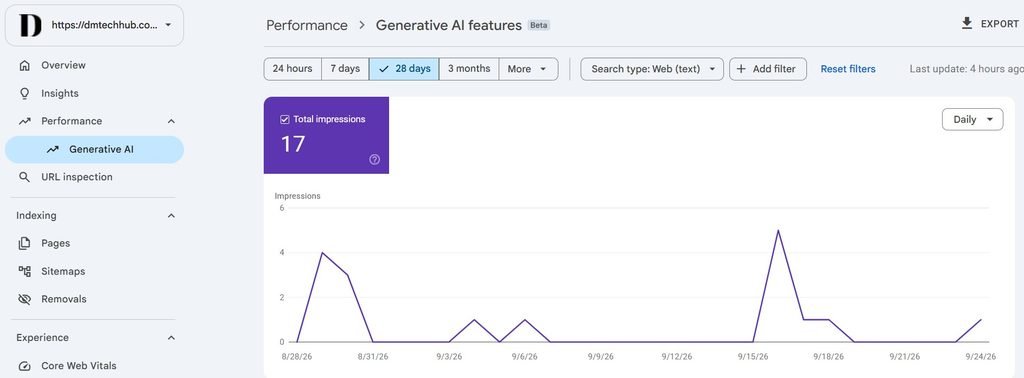
Beyond that dedicated report, watch your overall impressions, clicks, and click-through rate for queries that are likely to trigger AI features (typically longer, more complex, question-based queries). A rise in impressions paired with a falling CTR on those queries is a common pattern when a page is being pulled into a summary that answers the question without the user needing to click through.
Track brand search volume over time, since increased visibility inside AI-generated answers can sometimes show up as more people searching your brand name directly afterward, even if the initial click didn’t happen. Where available, cross-reference analytics referral data and any AI-specific tracking your analytics platform supports.
Manual monitoring still has a place. Periodically search the questions and terms that matter most to your business and note whether your site appears, how it’s represented, and whether that changes over time. This isn’t scalable across a large keyword set, but it’s a useful reality check against what Search Console is showing you in aggregate.
Be skeptical of any tool or vendor claiming a precise “AI visibility score” as if it were an official Google metric. Google has not published a universal ranking score for AI Overview or AI Mode inclusion, and Search Console’s generative AI reports, while real, are not a comprehensive log of every AI citation across the web.
A Practical 30-Day AI Search Optimization Plan
Week 1: Technical Foundation
Run a full crawl of your site and fix any crawlability issues, robots.txt blocks, and broken canonical tags. Confirm your important pages are indexed using Search Console’s URL Inspection tool. Check Core Web Vitals and fix the worst-performing pages. Clean up any obvious duplicate content.
Week 2: Content and Search Intent
Audit your top 15 to 20 pages by traffic or business importance. For each, check whether the direct answer appears early and whether the page covers the realistic follow-up questions a reader would have. Rewrite the two or three weakest pages with real examples and clearer structure.
Week 3: Authority, Internal Links, and Entity Signals
Map out your core topic clusters and identify gaps. Add contextual internal links connecting related content that currently isn’t linked together. Update author bios and your About page. Check that business information is consistent across your site and any external listings.
Week 4: Measurement and Content Improvements
Set a baseline in Search Console’s performance report and generative AI report if it’s available on your account. Identify five queries you’d like to appear for in AI Overviews or AI Mode and track your current position manually. Apply what you learned from weeks one through three to a second batch of pages, and schedule a recurring quarterly content refresh for your most important content.
Conclusion
AI Overviews and AI Mode are changing how search results look and how people interact with them, and Google’s own 2026 guidance is honest about that shift while also being clear that the underlying fundamentals haven’t changed. Crawlable, well-structured, genuinely useful content that demonstrates real expertise is still the foundation. What’s different is the scope: you’re now optimizing for a system that checks related subtopics through query fan-out, that increasingly carries a conversation across multiple turns, and that rewards depth and originality over generic coverage. Treat the practical steps in this article as an ongoing practice, not a one-time project, and keep grounding your strategy in what Google has actually published rather than the latest unverified claim making the rounds.