AEO vs GEO vs SEO: What Is the Difference and Which One Does Your Website Need?
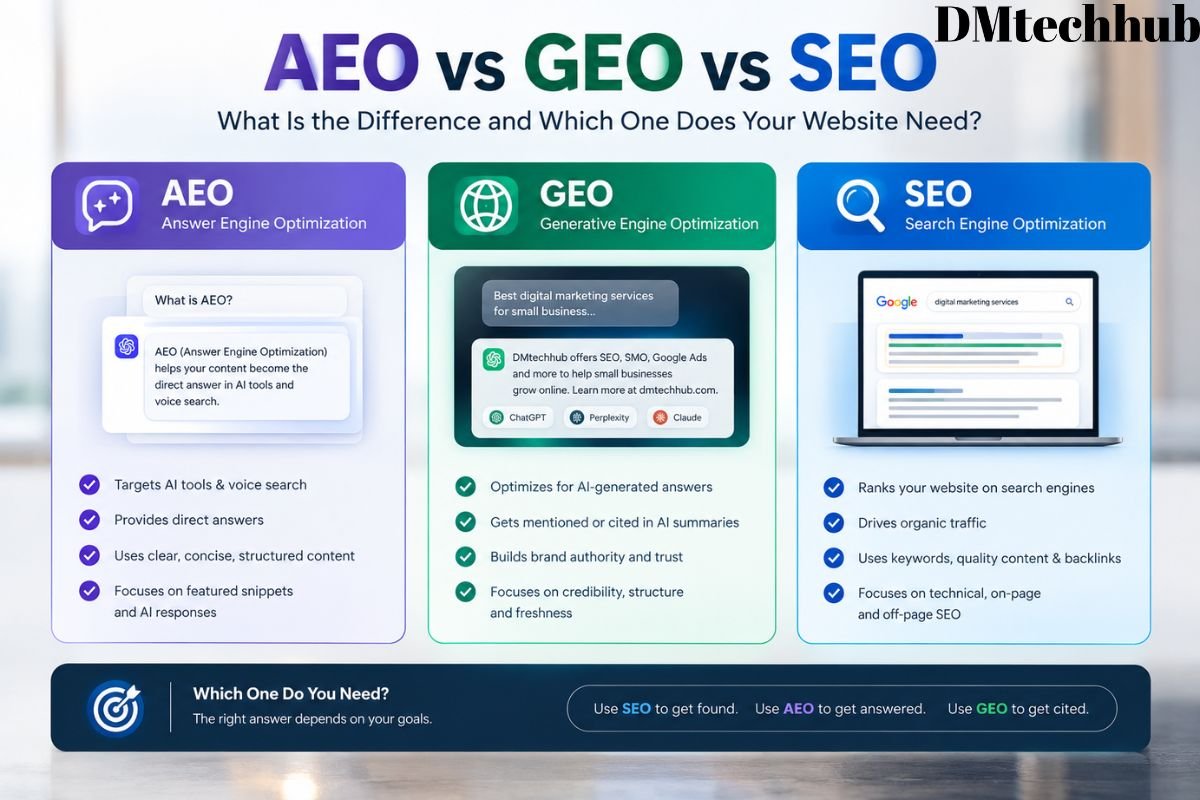
SEO helps your website and its pages rank in Google. AEO helps your content get picked as the direct answer to a user question. GEO helps AI tools like ChatGPT, Perplexity and Google AI Overviews mention or cite your brand when they write an answer.
Most websites need all three, just not at the same time. Start with SEO, add AEO next, then build GEO on top. If you only have time for one fix this week, make your pages easy to find and put a short, clear answer right under every question heading.
Key Takeaways
- SEO gets your website pages found, indexed and ranked. The other two sit on top of it.
- AEO is about writing answers that are short, clear and easy to lift out.
- GEO is about earning enough trust that AI tools mention your brand.
- AEO and GEO overlap a lot, so a small site shouldn’t treat them as two big projects.
- You don’t need a large budget. Clear writing and real expertise go a long way.
- Track mentions and citations, not just rankings.
Why This Feels So Confusing
A few years ago the goal was simple. Ranking on Google, get the clicks and impressions, move on.
Now people ask questions in Google, ChatGPT, Perplexity, voice assistants and even Reddit. Each place treats your content differently. On top of that, three acronyms showed up almost at once, and every article explains them in a slightly different way.
If you’re reading this, you probably have one of these worries
- My rankings look fine, but my clicks are dropping.
- Someone told me SEO is dead. Is that true?
- Are AEO and GEO two different things or the same thing?
- I have a small budget. Where do I even start?
- How do I find out if ChatGPT mentions my brand?
- Do I have to rewrite my whole website?
These are fair worries. The short answer is that search isn’t dying. It’s spreading out across more places. The rest of this guide takes each worry in turn.
What Is SEO?
SEO (Search Engine Optimization) is the work of helping Google and Bing find, understand and rank your webpages. The main goal is to show up when someone searches for what you offer, and to earn the clicks.
How SEO Works
Search engines do three jobs, in this order:
- Crawl: bots visit your pages by following links.
- Index: the search engine stores and sorts what it found.
- Rank: it orders pages by relevance, quality and how good the experience is.
What Actually Moves Rankings
Four things do most of the work:
- Search intent: your page should give people what they came for, not just repeat the keyword.
- Useful, original content: answer the question fully and add something other pages don’t.
- Technical health: fast loading, mobile-friendly pages and a clean site structure.
- Trust: links from respected sites, real authors and accurate facts.
Is SEO Still Worth It?
Yes. People still use Google every day to compare products, find local services and decide what to buy. Searches like “digital marketing agency near me” or “best running shoes for flat feet” often end in a sale.
There’s another reason. Google’s own guidance on its AI features points back to the usual basics: pages Google can crawl, helpful content and a good page experience. AI answers also tend to draw from pages that already perform well in normal search.
Think of SEO as the ground floor. You can build AEO and GEO above it, but they need something solid underneath.
What Is AEO?
AEO (Answer Engine Optimization) is the practice of writing and structuring content so that search engines, voice assistants and AI tools can pull out a clear answer and show it directly.
Here’s the simplest way I can put it. SEO asks, “Can people find my page?” AEO asks, “Can a machine quickly find the answer on my page?”
Where AEO Shows Up
- Featured snippets on Google
- “People also ask” boxes
- Voice answers from Siri, Alexa and Google Assistant
- Short answers inside AI tools
How to Write for AEO
Start by using real questions as your headings. Then answer the question in the first sentence or two, and add the detail after.
Keep paragraphs short. Use lists for steps and tables for comparisons, because they’re easy for machines (and tired humans) to scan. Where it fits, add schema markup such as FAQ or HowTo, which tells machines what each part of the page is.
A Quick Before and After
Here’s a weak opening for a section called “What is the difference between AEO and SEO?”
“There are lots of things to think about when comparing AEO and SEO, and the right answer depends on your goals.”
And a stronger one:
“SEO helps your page rank in search results. AEO shapes your content so it can be shown as the direct answer. Most sites need both.”
The second version can be lifted out and used without any editing. That’s the whole idea behind AEO.
What Is GEO?
GEO (Generative Engine Optimization) is the work of making your brand and content easy for AI tools to understand, trust and include when they write their own answers.
Tools like ChatGPT, Perplexity, Gemini and Google AI Overviews don’t just hand over a list of links. They gather information from several places and write a fresh response. GEO is about being one of the places they pick, or one of the names they mention.
How an AI Tool Builds an Answer
The exact process differs from tool to tool, but in simple terms it goes like this:
- It reads the question and works out what the person wants.
- It pulls useful passages from several pages or sources.
- It blends them into one written answer.
- Sometimes it shows links or names its sources.
Your content isn’t copied word for word. It becomes raw material. That’s why clear, factual and well-supported writing has a better chance than vague, generic text.
What Helps With GEO
- Original insight: your own examples, data, case studies and opinions. If your page repeats what ten other pages say, an AI tool has little reason to pick yours.
- Consistent brand details: use the same name, description and contact details everywhere you appear.
- Mentions beyond your site: reviews, forum threads, directory listings, press and YouTube all help AI tools figure out who you are.
- Topic depth: cover the related questions, so your page gives full context.
- Fresh facts: update your key pages so the numbers and details stay current.
- Visible trust: real author names, short bios and an honest About page.
The Honest Downside
GEO doesn’t always bring a click. An AI tool might mention your brand with no link at all, or show a link that few people tap.
So GEO is often about being known and trusted, not only about traffic. That’s a harder thing to measure, and it takes longer to build.
SEO vs AEO vs GEO at a Glance
| Point | SEO | AEO | GEO |
|---|---|---|---|
| Full name | Search Engine Optimization | Answer Engine Optimization | Generative Engine Optimization |
| Main goal | Rank pages and earn clicks | Be the direct answer | Be cited or mentioned in AI-written answers |
| Where it shows up | Google and Bing results | Snippets, voice answers, answer boxes | ChatGPT, Perplexity, Gemini, AI Overviews |
| What you work on | Keywords, links, site health | Question headings, short answers, schema | Original insight, brand trust, mentions elsewhere |
| Best content style | Complete, helpful pages | Answer first, detail after | Deep, factual, quotable content |
| Success looks like | Rankings, traffic, leads | Snippet and voice answer wins | Citations and brand mentions |
Are AEO and GEO the Same Thing?
This is the question I see most often, and the honest answer is that it depends on who you ask.
Some agencies treat them as one job with two names. Others draw a firm line between them. Both sides have a point.
Why Some People Say They’re Different
- AEO works at the page level. It asks whether this page will be picked as the answer.
- GEO works at the brand level. It asks whether AI tools know, trust and recommend your brand.
- AEO is mostly about your own site. GEO also depends on what other sites say about you.
Why Others Say They’re Nearly Identical
- Both aim to get you into an AI-style answer.
- Both rely on clear writing, good structure and trust signals.
- On a small business site, the to-do list for both looks almost the same.
Where I Land
I’d treat AEO as the page-level craft and GEO as the brand-level reputation. You’ll work on them side by side. If someone sells them as two separate, expensive packages for a small site, ask them to spell out exactly what’s different in the work.
One Article, Three Results
Say you run a finance blog, and someone asks: “What is the difference between a fixed and a floating interest rate?”
With good SEO, your guide ranks on page one for that search. A reader clicks through and reads it.
With good AEO, your first lines say, “A fixed rate stays the same for the whole loan period. A floating rate moves with the market.” Google shows that sentence in a snippet with a link to you.
With good GEO, someone asks ChatGPT or Perplexity the same question. The tool writes its own explanation and lists your site as a source, or names your brand as a trusted guide.
It’s the same article each time. That’s why one well-built page can work for all three.
Which One Does Your Website Need?
It depends on the kind of site you run and how far along you are.
| Type of website | Start with | Add next | Why |
|---|---|---|---|
| New blog | SEO | AEO | You have to be found before you can be quoted |
| Local business | Local SEO | AEO, then GEO | Reviews and your Google Business Profile feed both Google and AI tools |
| Online store | SEO | AEO | Shoppers search for products and want quick answers on size, price and delivery |
| Software or SaaS brand | SEO and AEO | GEO | Buyers often ask AI tools for the best tool for a task |
| Agency or consultant | SEO and GEO | AEO | Trust and reputation decide who gets recommended |
| News or research site | SEO and GEO | AEO | Fresh, credible facts get cited often |
| FAQ or help center | AEO | SEO | The content is already in question and answer form |
A Simple Rule of Thumb
- If you don’t rank for anything yet, start with SEO.
- If you rank but rarely get snippets or AI mentions, work on AEO.
- If your brand is small and AI tools never name you, build GEO signals.
I wouldn’t chase GEO first if your SEO is weak. AI tools lean on sources that already look trustworthy, and that trust usually starts with a solid, well-indexed site.
Where to Start: Six Practical Steps
You don’t need three separate plans. One clean workflow covers all of it.
Step 1: Fix the SEO Basics
Make sure Google can crawl and index your pages. Speed up slow pages, check the mobile layout, write unique titles and meta descriptions, and link related pages to each other. Remove thin or duplicate pages while you’re at it.
Step 2: Put the Answer First
Open each section with a direct answer of about 40 to 60 words. Use questions as your H2 and H3 headings. Add a table when you compare things and a numbered list when you explain steps.
Step 3: Add Structured Data
Use Article, Organization and Person schema so machines know who you are and what the page is. Add FAQ or HowTo schema where the content really matches. Test it with Google’s Rich Results Test.
Step 4: Show Real Experience
Add author names and short bios. Share your own examples, screenshots, numbers or case studies. Link to trusted sources when you state a fact, and be honest when you don’t know something.
Step 5: Build Your Presence Off Your Site
If you serve a local area, complete your Google Business Profile. Keep your brand name and description the same on every profile. Ask happy customers for honest reviews. Join conversations on Reddit, Quora and industry forums, and focus on being helpful, not salesy.
Step 6: Keep Pages Fresh
Review your best pages every few months. Fix outdated facts and broken links, and show a last updated date so readers (and machines) can see the page is current.
Common Mistakes to Avoid
- Treating AI search like old SEO. Stuffing keywords won’t help. These tools care about meaning and clarity.
- Hiding the answer. If it sits in paragraph six, a machine may skip it, and so will a busy reader.
- Publishing raw AI-written text. Generic content adds nothing new, so there’s no reason for anyone to cite it.
- Ignoring schema completely. It’s not magic, but it helps machines read your page correctly.
- Existing only on your own website. If nobody else mentions you, AI tools have little proof you’re real.
- Buying every new acronym. Do the basics well before you pay for add-on services.
- Skipping measurement. If you never check, you’ll never know what works.
- Expecting guarantees. Nobody can promise you a spot in an AI answer. Google itself says AI Overviews don’t appear for every search.
How to Tell If It’s Working
Each approach has its own scoreboard.
| Approach | What to track | Where to look |
|---|---|---|
| SEO | Rankings, organic clicks, impressions, leads | Google Search Console, Google Analytics |
| AEO | Featured snippets, “People also ask” spots, voice answers | Search Console, manual searches, rank tracking tools |
| GEO | Brand mentions, citations, visits from AI tools | Manual prompts, analytics referral reports, AI tracking tools |
A Free Way to Check Your GEO
- Write down 10 questions your customers really ask.
- Ask each one in ChatGPT, Perplexity, Gemini and Google.
- Note whether your brand or page shows up, and who does instead.
- Repeat once a month and compare.
It takes about an hour, and it shows your gaps fast.
What Comes Next?
New labels keep appearing. You may have seen AI Optimization, LLM Optimization or Search Everywhere Optimization. They all point at the same idea: be useful, be clear and be trusted wherever people look for answers.
I’d keep an eye on three things. More answers will appear without a click, so visibility will matter even when traffic doesn’t follow. AI tools will lean toward brands they see mentioned in many places. And answers will mix text, images, video and voice.
None of that changes the plan. Build real expertise and publish things that deserve to be quoted.
Conclusion
SEO, AEO and GEO aren’t rivals. They’re three layers of the same job.
SEO gets you found. AEO makes your answers easy to lift out. GEO helps AI tools know and trust your brand.
Start with a healthy, well-indexed site. Rewrite your most important pages so the answer comes first. Then build your reputation around the web with reviews, mentions and original insight.
You don’t need a big budget to begin. You need clear writing, honest expertise and some patience.
Frequently Asked Questions
1. What is the main difference between SEO, AEO and GEO?
SEO ranks your pages in search results. AEO makes your content the direct answer to a question. GEO helps AI tools mention or cite your brand inside the answers they write.
2. Is SEO dead because of AI search?
No. People still search on Google every day, and AI answers often draw from pages that already rank well. What has changed is that rankings alone no longer tell the full story.
3. Is GEO the same as AEO?
Not exactly, but they overlap heavily. AEO is mostly about making single pages answer-ready. GEO is more about building brand trust so AI tools recommend you. Most sites work on both together.
4. Do I need AEO if I already do SEO?
It’s worth adding. SEO gets you ranked, but answer-first writing and clean structure help your content show up in snippets, voice results and AI summaries.
5. Can a small website compete in AI answers?
Yes. These tools care a lot about clarity, relevance and trust. A small site with focused, original content can be cited next to much larger brands.
6. How do I get my website cited by ChatGPT or Perplexity?
Publish clear, factual and original content. Keep your pages crawlable, add schema and earn mentions on other trusted sites. Nobody can guarantee a citation, but these steps raise your chances.
7. Does schema markup help with AEO and GEO?
It helps machines understand what each part of your page means. It isn’t a ranking trick, but it supports clean extraction and clearer context.
8. Will AEO reduce my website traffic?
It can reduce clicks on simple questions, because people get the answer on the results page. The visitors who do click are often more interested, and your brand still gets seen.
9. Do backlinks still matter?
Yes. Links from respected sites act as trust signals for search engines, and they help your brand look credible to AI tools too.
10. How long do results take?
SEO usually takes a few months. Changes to a single page for AEO can show results sooner. GEO builds slowly because it depends on your reputation across the web.
11. How do I know if AI tools mention my brand?
Ask your key customer questions in ChatGPT, Perplexity, Gemini and Google, and note what appears. You can also check your analytics for visits from AI platforms.
12. Should I use AI to write my content?
AI can help with outlines and editing. But raw, unedited AI text tends to be generic. Add your own experience, data and examples so the page is worth citing.