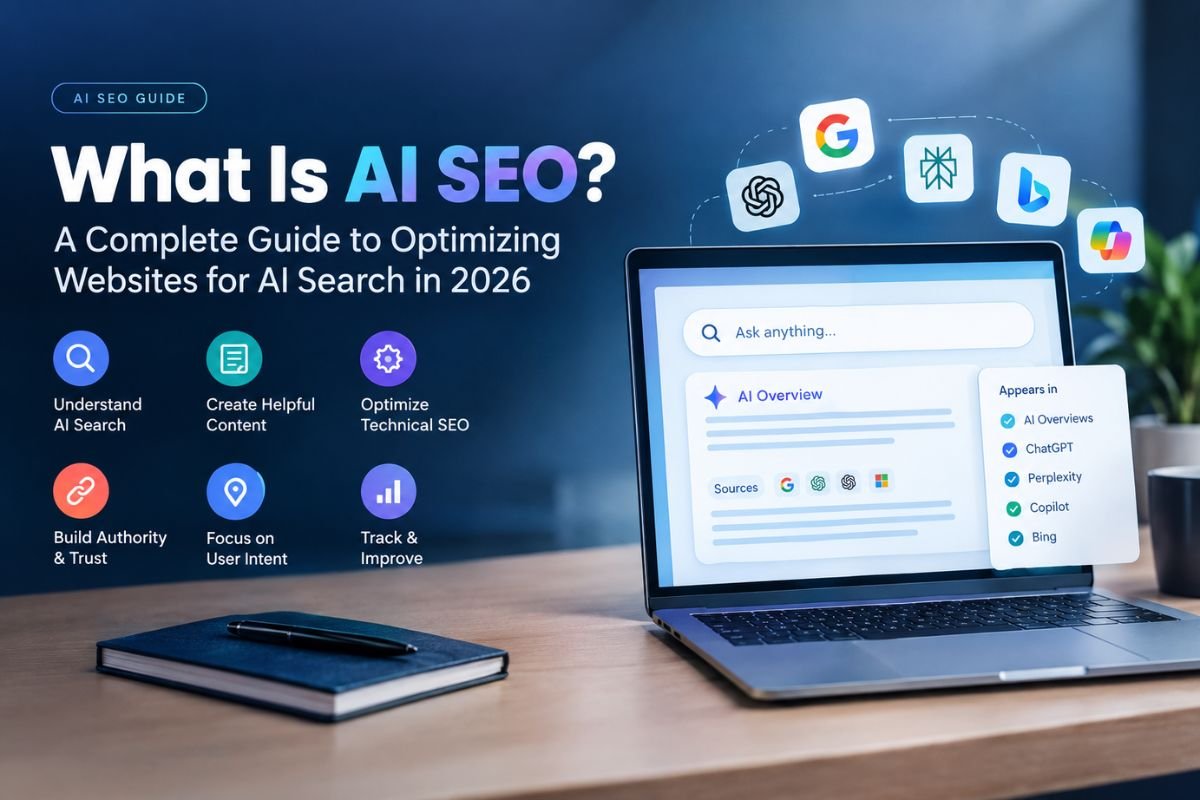
What Is AI SEO? A Complete Guide to Optimizing Websites for AI Search in 2026
AI SEO is the practice of making your website easy for AI search systems to find, understand, trust, and cite. It builds on classic SEO and adds attention to how AI tools retrieve information, which sources they pick, and how your brand is described in generated answers.
Key takeaways
- AI SEO is an extension of SEO, not a replacement. Google says its generative features are rooted in its core ranking and quality systems.
- Most tactics that win in AI search are the ones that win everywhere: crawlable pages, original content, real expertise, clear entities, and a strong reputation.
- Each AI platform has its own crawlers and reporting, so access and measurement need platform-specific setup.
- Several popular “AI hacks” are unproven or officially unnecessary for Google. Skip them until you have the basics covered.
- Measure visibility, accuracy, and business impact, not just clicks.
What is AI SEO?
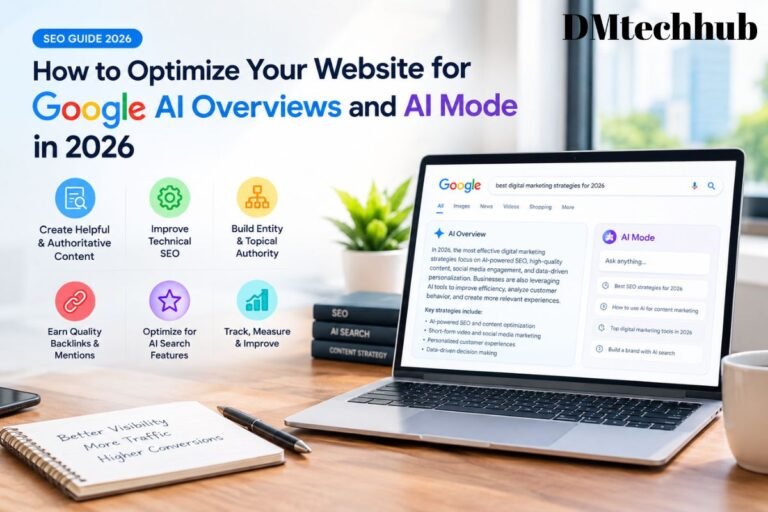
AI SEO means optimizing your website and brand for search experiences that generate answers instead of only listing links. These include Google’s AI Overviews and AI Mode, ChatGPT search, Perplexity, and Microsoft Copilot.
In a traditional results page, your goal is to earn a position and a click. In an AI answer, your goal is often to be one of the sources the system draws from, and to be described accurately when it does.
That changes the questions you ask about a page:
- Can AI systems access it?
- Does it say something worth citing that other pages don’t?
- Is it clear who wrote it and why they are qualified?
- Is your brand consistently described across the web?
If the answer to all four is yes, you are already doing most of what AI SEO requires.
AI SEO vs traditional SEO vs AEO vs GEO
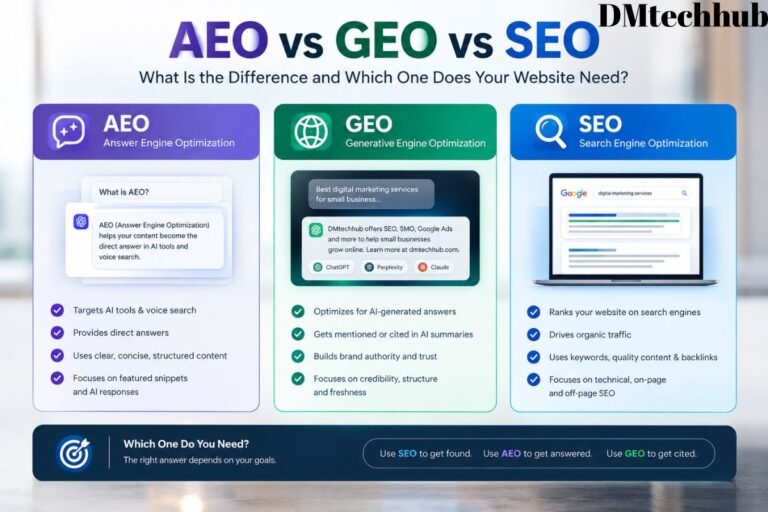
These terms overlap, and vendors use them inconsistently. Here is a practical way to separate them.
| Term | What it means | Main goal | Typical tactics |
|---|---|---|---|
| Traditional SEO | Optimizing pages to rank in search results | Rankings, clicks | Keyword research, technical health, links, content |
| AEO (Answer Engine Optimization) | Structuring content so it can be used as a direct answer (featured snippets, voice, AI answers) | Being the answer | Clear definitions, question-led headings, concise answers |
| GEO (Generative Engine Optimization) | Improving how often and how well generative AI tools use or mention you | Being cited or recommended in generated responses | Original insight, brand authority, third-party coverage |
| AI SEO | The umbrella discipline covering all of the above | Visibility across classic and AI search | SEO fundamentals plus AI-specific access, entity, and measurement work |
One caveat matters here. Google’s guidance says that from its perspective, optimizing for generative AI search is optimizing for the search experience, and thus still SEO. Treat AEO and GEO as useful lenses, not separate disciplines that need separate teams.
How AI search works
Understanding the mechanics explains why the strategies below work.
Retrieval and grounding
Most AI search products do not answer from memory alone. They retrieve fresh web pages, then generate an answer from what they found. Google describes this as retrieval-augmented generation, where its core Search ranking systems retrieve relevant pages from the index and the model then reviews that information to produce a response with clickable links.
The practical takeaway: if a page can’t be crawled, indexed, and understood, it can’t be used.
Query fan-out
AI systems often break one question into many. Google calls this query fan-out: the model generates a set of related queries at the same time to pull in more results. google
Take a prompt like “best accounting software for a 10-person design agency.” Behind the scenes, the system may also look for pricing, invoicing features, integrations with project tools, and reviews from agencies. A page that answers only the headline question may lose to a set of pages that cover the whole decision
How the major platforms differ
| Platform | How it finds sources | What site owners should do | First-party reporting |
|---|---|---|---|
| Google AI Overviews and AI Mode | Google’s own index and ranking systems | Be indexed and snippet-eligible; follow standard SEO | Search Console Generative AI report |
| ChatGPT search | OpenAI’s search crawler plus other sources | Allow OAI-SearchBot; keep content public and clear | Referral tagging with utm_source=chatgpt.com |
| Perplexity | Its own crawler and index, with numbered citations | Allow PerplexityBot; keep answers specific and current | None; measure manually |
| Microsoft Copilot | Bing-connected retrieval and partner integrations | Verify in Bing Webmaster Tools; submit sitemaps | Bing Webmaster Tools AI Performance |
Google AI Overviews and AI Mode
Scale is the reason this matters. Google reported that AI Overviews has over 2.5 billion monthly active users and AI Mode has surpassed one billion monthly users. Google has also been blending the two so that a quick overview can lead into a longer conversational session. To appear, a page must be indexed and eligible for a snippet, and your site must not have opted out through the Search Console generative AI control.
ChatGPT search
OpenAI documents separate crawlers for separate jobs. For inclusion in ChatGPT search summaries and snippets, make sure you aren’t blocking OAI-SearchBot. GPTBot relates to training and is a separate switch, so blocking it does not remove you from ChatGPT search. OpenAI also says ChatGPT adds utm_source=chatgpt.com to referral URLs, which makes traffic easy to spot in analytics.
Perplexity
Perplexity runs two agents. PerplexityBot supports its search index, while Perplexity-User fetches pages during live questions and, per its documentation as summarized by one reference, generally ignores robots.txt rules. Perplexity displays numbered citations prominently, so being specific and quotable pays off here.
Microsoft Copilot
Microsoft gives site owners the most direct window of any AI platform. Its AI Performance report in Bing Webmaster Tools shows which pages are cited, how visibility trends over time, and the grounding queries tied to your content. In June 2026 Microsoft added Intents, Topics, Citation Share, and Compare views in preview.
Other AI experiences.
Gemini, Claude, and other assistants also retrieve web content, and vendors keep adding or renaming crawlers. Re-check each vendor’s official documentation before changing robots.txt rules.
Why AI SEO matters now
Three shifts make this worth your attention:
- Answers appear before links. Users may get what they need without visiting a site, especially for early-stage informational queries.
- Discovery is fragmented. People ask questions in Google, ChatGPT, Perplexity, Copilot, and inside apps.
- Brand descriptions are generated. An AI tool may summarize your pricing, strengths, or reputation whether or not you wrote that summary. If your public information is outdated or inconsistent, the summary will be too.
This does not mean clicks have stopped mattering. It means visibility, accuracy, and brand recall now sit next to traffic as things worth tracking.
The core AI SEO strategies
1. Crawlability and indexation
Everything starts here. Google states that to appear in its generative features, a page must be indexed and eligible to be shown in Search with a snippet.
Action steps:
- Confirm key pages return 200 status codes and are indexable.
- Check that robots.txt, CDN rules, and firewalls aren’t accidentally blocking search-related bots. A robots.txt allowance does nothing if a WAF rejects the request.
- Keep an up-to-date XML sitemap.
- Make sure important content appears in rendered HTML and isn’t locked behind logins, pop-ups, or scripts that fail.
- Use clean canonical tags to reduce duplicate URLs.
- Decide deliberately which crawlers to allow. Search and retrieval bots affect visibility. Training bots affect how your content is used in model development. These are different decisions.
A simple robots.txt pattern for a business that wants ChatGPT search visibility but not OpenAI training:
Whether to block training crawlers is a business decision. Blocking them will not affect your Google rankings, but be aware of what each token controls before you copy any template.
2. Helpful, non-commodity content
Google’s guide is blunt on this point: unique, compelling content will likely influence generative AI visibility more than any other tip in it. It draws a helpful contrast between commodity content (advice anyone could write) and non-commodity content (experience-based takes that go beyond common knowledge).
Compare two article ideas for a mortgage broker:
- Commodity: “7 Tips for First-Time Homebuyers”
- Non-commodity: “What we saw across 140 first-time buyer applications last year, and the three paperwork errors that delayed closings”
The second contains information an AI can’t invent and competitors can’t copy.
Action steps:
- Add first-hand evidence: original data, screenshots, case notes, test results, quotes from named practitioners.
- Answer the follow-up questions a reader would ask next.
- Take a position. Summaries of what page one already says add nothing.
- Support text with useful images and video where they clarify something.
3. E-E-A-T (experience, expertise, authoritativeness, trust)
E-E-A-T is a quality framework, not a single ranking factor. AI systems need trustworthy sources, so signals of real credibility matter, especially for health, money, and legal topics.
Action steps:
- Show named authors with real bios and relevant credentials.
- Add reviewer information for sensitive topics (for example, “medically reviewed by”).
- Publish clear About, Contact, editorial, and refund or return policy pages.
- Cite primary sources and link to them.
- Put dates on time-sensitive content and update them only when you actually change something.
4. Entity optimization
An entity is a distinct thing a system can recognize: your company, a product, a founder, a service category. AI tools work better when they can tell exactly who you are and what you offer.
Action steps:
- Use one consistent brand name, description, and set of core facts across your site, social profiles, directories, and press.
- Create a clear “About” page and dedicated pages for each major product or service.
- Add Organization and Person structured data, including sameAs links to your official profiles.
- For local and retail businesses, keep Google Business Profile and Merchant Center data accurate. Google notes these help products and local businesses appear in AI responses.
- Define your terminology. If you call something three different names across your site, say so once and stay consistent.
5. Topical authority
Topical authority means being the site that covers a subject thoroughly and reliably. Instead of publishing 50 unrelated posts, build depth around the subjects you want to be known for.
Action steps:
- Pick three to five core topics tied to revenue.
- For each, build one comprehensive guide plus supporting pages on subtopics, comparisons, costs, mistakes, and use cases.
- Base the subtopics on real customer questions from sales calls, support tickets, and site search, not only on keyword tools.
- Avoid producing pages for every phrasing variation. Google explicitly warns that creating content for each variation mainly to manipulate rankings or AI responses can violate its scaled content abuse policy.
6. Semantic relevance and conversational queries
You do not need to hunt for every long-tail phrase. Google notes its systems understand synonyms and meaning, so you don’t need to worry about lacking every variation of how someone might ask.
What you do need is to answer the real question fully, in natural language.
Action steps:
- Write headings the way people actually ask: “How long does SEO take for a new website?”
- Put a direct answer in the first one or two sentences, then add nuance.
- Cover related concepts a knowledgeable person would mention, without forced keyword repetition.
- Address follow-ups (“What does it cost?”, “What are the risks?”, “Is it worth it for a small team?”) on the same page or through clear internal links.
7. Structured data
Structured data helps machines interpret your pages and still supports rich results for many content types. But keep expectations realistic:
- Google says structured data isn’t required for generative AI search and no special schema.org markup is needed.
- Google FAQ rich results stopped appearing on May 7, 2026. FAQPage remains valid schema.org markup, and unused structured data causes no harm, but adding it to win SERP space no longer makes sense.
- The markup must match visible page content.
Where it’s still worth using: Organization, Person, Article, Product and merchant listings, LocalBusiness, Breadcrumb, Video, and Review snippets where eligible. Validate with Google’s Rich Results Test and the Schema.org validator.
8. Citations and mentions
AI systems reflect what the wider web says about you, including news coverage, reviews, community discussions, and industry directories. But this is an area where shortcuts backfire. Google specifically calls out that seeking inauthentic mentions across the web is not as helpful as it might seem.
Action steps that hold up:
- Publish original research or data that others want to reference.
- Contribute expert commentary to trade publications and podcasts.
- Encourage genuine customer reviews on the platforms your buyers use.
- Participate honestly in communities where your audience asks questions, and disclose your affiliation.
- Monitor which third-party sites AI answers cite in your category, and consider whether you have a legitimate reason to be there.
9. Internal linking
Internal links tell both users and crawlers how your ideas connect. They also help new pages get discovered quickly.
Action steps:
- Link from your pillar guide to each supporting page, and back.
- Use descriptive anchor text such as “local SEO checklist for clinics,” not “click here.”
- Link from high-traffic pages to newer pages that deserve attention.
- Fix orphan pages that no other page links to.
- Keep navigation and breadcrumbs consistent so the topic structure is obvious
10. Content optimization for extraction and freshness
Good structure helps people first, and it happens to help retrieval systems too. But keep it in proportion. Google says there’s no need to chop content into tiny “chunks” for AI, and that it doesn’t require writing in a special style for AI systems.
Action steps:
- Use descriptive headings, short paragraphs, and lists or tables where content is truly list-like or comparative.
- State key facts plainly: prices, dates, specifications, eligibility rules, and definitions.
- Include a short summary near the top of long guides.
- Refresh pages when facts change, and note what changed. Meaningful updates beat cosmetic date changes.
Myths and hype: what to skip or treat with caution
| Tactic | Reality check for 2026 |
|---|---|
| llms.txt | Google says its Search doesn’t use these files. Other tools may. Optional, low priority. |
| Rewriting everything for AI | Unnecessary for Google. Write for readers. |
| Chunking pages into tiny sections | Not required. Clear structure is enough. |
| Mass-producing pages for every query variation | Risks violating scaled content abuse policy. |
| Buying or faking mentions | Ineffective and risky. Earn real coverage. |
| Adding FAQ schema to everything | FAQ rich results are gone in Google. Keep FAQ content where it helps users. |
| Guaranteed “AI ranking” services | No third party can see Google’s internal ranking or AI systems. Treat claims skeptically. |
A practical 30-day AI SEO plan
| Week | Focus | Tasks |
|---|---|---|
| 1 | Access and baseline | Audit indexation, robots.txt, and firewall rules. Verify Search Console and Bing Webmaster Tools. Record current AI impressions and citations. Build a prompt list of 25 to 30 questions your customers ask. |
| 2 | Entities and trust | Standardize brand description. Add Organization and Person schema. Improve author pages and About page. Fix Google Business Profile details. |
| 3 | Content upgrades | Pick your ten most valuable pages. Add original evidence, direct answers, updated facts, and internal links. Remove or merge thin duplicates. |
| 4 | Gaps and measurement | Publish one non-commodity page per core topic. Run your prompt list across AI tools and log mentions, citations, and accuracy. Set a monthly review. |
Two examples
Local physiotherapy clinic. A page titled “Physiotherapy in [City]” says little that competitors don’t. The upgrade: named physiotherapists with credentials, a page on recovery timelines for common injuries using the clinic’s own aggregate outcomes, clear pricing and insurance details, accurate Business Profile data, and links between each condition page and the relevant clinician.
B2B accounting software company. Instead of another “best accounting software” listicle, publish a benchmark of how long month-end close takes across customer sizes, a comparison table of integrations, and honest guidance on who the product is not for. Those are the passages AI tools and buyers both find useful.
Common AI SEO mistakes
- Blocking the wrong bots. Teams disallow everything “AI” and lose search visibility along with training access.
- Chasing tricks over fundamentals. Broken indexation beats any schema trick.
- Publishing volume instead of value. Ten thin pages are weaker than one strong page.
- Inconsistent brand facts. Conflicting descriptions, prices, or locations across the web produce confused summaries.
- Ignoring accuracy in AI answers. If a tool misstates your offering, find the outdated source and fix it.
- Treating AI Overviews as win or lose. Appearance and click value are separate questions.
- Measuring only clicks. You may be influencing decisions that show up later as branded searches or direct visits.
- Letting content go stale. Outdated pricing and statistics erode trust quickly.
- Over-relying on third-party AI visibility scores. Many rely on sampled prompts and vary between runs and users.
How to measure AI search visibility
No single dashboard covers everything, so combine sources.
| What to measure | Where | Notes |
|---|---|---|
| Impressions in AI Overviews and AI Mode | Search Console, Generative AI report | Shows impressions by page, country, device, and date. It does not include click data. Rolled out to all sites worldwide as of August 31, 2026. |
| Citations in Copilot and Bing AI answers | Bing Webmaster Tools, AI Performance | Shows cited pages and grounding queries. Covers Microsoft surfaces only. |
| Referral visits from AI tools | GA4 or your analytics | ChatGPT tags referrals with utm_source=chatgpt.com. Check whether your GA4 has an AI channel grouping, and add a custom channel if some tools land in generic referral. |
| Crawler activity | Server logs | Look for OAI-SearchBot, PerplexityBot, and others, plus status codes. Verify by published IP ranges. |
| Brand presence and accuracy | Manual prompt testing | Run the same 25 to 30 prompts monthly. Log whether you’re mentioned, cited, and described correctly. Expect variation between runs. |
| Business impact | CRM and analytics | Ask new leads how they found you. Track branded search and direct traffic trends. |
Two cautions. First, treat prompt-tracking tools as directional. Answers vary by user, location, and time. Second, use impressions to compare your own pages against each other, not as a traffic forecast.
Frequently Asked Questions
Conclusion
AI SEO is best understood as SEO with a wider definition of visibility. The winners will not be the teams with the cleverest hacks. They will be the sites AI systems can access easily, that say something original, that are clearly written by credible people, and that are consistently described across the web.
Start with access and measurement, fix your entity basics, upgrade your most valuable pages with first-hand evidence, and review results monthly. Platforms will keep changing their features and reports, but pages that serve readers well hold their value through those changes.