On Page SEO in 2026: What it is and How To Do it in Right Way
In 2026, SEO is no longer just about placing the right keywords in your content, it’s about creating helpful, meaningful, unique and creative context rich experiences for both the users and search engines. Today different search engines like chatgpt, google have become more intelligent systems. They not only scan your webpage for keywords but try to understand the user intent, context and usefulness of the content like a human reader.
Simply, on page seo is the process of optimising different elements of your webpage so that it communicates valuable content, answers user queries effectively and provides a smooth user experience.
Let’s understand what exactly it is and how to do it the right way.
What is on page seo
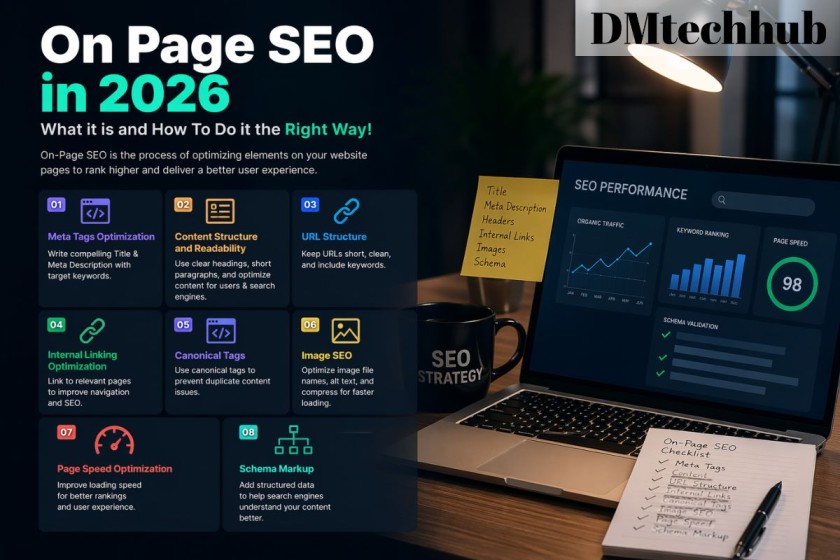
On page seo is a process through which it we optimize and update different parts of a website or a webpage such as
- Meta Tags Optimization
- Content Structure and Readability
- URL structure
- Internal linking optimization
- Canonical tags
- Image SEO
- Page speed optimization
- Schema markup
On page seo is the practice of optimising different elements of individual webpages of your website to achieve good ranking positions in search engine result pages, improve user experience and gain high quality relevant traffic to the website.
It’s all about making your website user friendly. Let’s understand them one by one.
Meta tags Optimization
Meta tags are the snippets of html code that give important information about a webpage to both search engines and website visitors. They are placed in the head section of an HTML document and do not appear in the actual webpage.
Key Aspects of Meta Tags
- Title tags:
Title tags are present in the <head section of HTML document and appear as a clickable headline on search engine result pages (SERPs). It is often referred to as page title or meta title. It tells the search engines and users about the main idea of a webpage content. It is present in source code as given below.

- Meta Descriptions:
It is a short summary of a webpage content and appears below the title tags in search engine result pages. It is roughly around 155 characters. Its main goal is to convince users to click your website link rather than competitor’s link. It is present in source code as given below

- Robots Tags:
Robots tags are a piece of code present in the HTML document of a webpage and tells the search engine crawlers how to crawl, index and display a page’s content. It is present in the head section of the HTML snippet. It’s prese
nt in source code of a webpage as given below

- Meta Viewport:
Viewport helps your webpage display properly on mobile devices. It is present in the head section of the HTML document of a webpage content and instructs the search engines, especially on mobile devices, how to display your content on mobile devices. It’s code is given below as

Content Structure and Readability in SEO
It refers to how well your written content is organized and how easy it is for users and search engines to understand it.
Here are some key points for content structure and readability in seo
- Use main heading <h1> in the content for the title and h2, h3, h4 for the sub headings.
- Write the content in short paragraphs.
- Use bullet points and lists in the content
- Maintain a logical flow of information
- Create your content in a simple and easy to understand way.
- Avoid writing long and complex sentences in the content.
- Highlight the important information wherever needed.
- Make the content scannable for users.
A well defined content structure includes proper headings(h1, h2, h3 ), short paragraphs, bullet points and logical flow to guide the readers throughout the whole content.
While readability focuses on using simple and plain language, shorter sentences and clear formatting so that readers can quickly scan your information.
A well structured and readable content improves the user experience, reduces bounce rate and helps search engines better understand your content which leads to more engagement of your content.
URL structure in SEO
A URL is the address of any specific webpage or website present on the internet. For example, the URL looks like this
“https://dmtechhub.com/search-engine-optimization/”
URL structure in SEO refers to the organized, readable format of a website’s address which includes keywords, separated by hyphen so that users and search engines can easily understand the webpage content.
A well structured url is clean, readable and meaningful. It is also an important part of on page seo that improves the user experience and visibility in search engines.
Good url: www.example.com/meta-ads-services/
Bad url: www.example.com/page?id=12345
Internal linking in SEO
Internal linking is a process of creating hyperlinks between two webpages within the same domain. It is crucial for establishing content hierarchy and these internal links help navigate users through different webpages and also guide search engines like Google to understand your website structure.
Why internal links matter
It helps in
- Improving website navigation.
- Passing link juice from one page to another.
- Search engines discover and index your webpages faster.
- Also increase user spending time on the website.
How to do it
- Link relevant pages naturally within your content.
- Use clear and relevant anchor texts
Canonical Tags
A canonical tag is an html snippet present in the
section of a webpage that tells the search engines like Google which version of a URL is the main or original one when there are multiple similar or duplicate urls available in the website.It helps in preventing duplicate content issues.
Here’s the code of canonical tags present in the webpage

The main purpose of canonical tags is to inform search engines which page is the main and original version, preventing duplicate content issues. It consolidates the link equity from duplicate urls and improves the crawling and indexing of urls.
Image SEO
It is a process of optimizing images in your website so that search engines like Google index them and show them in the search engine result pages (SERPs). Image SEO rank your website images in google and also improve the website seo performance.
How to do Image SEO
- File Names: Use descriptive file names of images and use keywords in file names. File name should be as on-page-seo-checklist.jpeg. Google recommends that file names should be separated by hypens(-) .
- Alt Text:Write a short description of the image in the alt attribute of the HTML snippet. This helps search engines like Google understand about the image.
- Reduce Image file size: Use tools to reduce or compress the image file size without losing the quality so that image load faster.
- Use right format for the image: Use webp or avif image format instead of JPEG/PNG formats. They provide superior quality instead of older ones.
- Use Lazy load: Use lazy loading in the website i.e when users scrolls to images then only images load helps in improving page load time.
Page Speed Optimization
Page speed measures how fast your website loads and becomes interactive to users. Page speed optimization focuses on reducing the loading time of a website so that search engines like Google can rank your website better.
It is the process of making your website fast , smooth and user-interactive.
How to optimize page speed
- Optimising images
Compressing the image file size and converting to modern formats like webpage. - Code Minification
Reduce and remove the unnecessary html file, CSS and javascript files. - Enabling Lazy loading
Lazy loading involves the delaying of images and videos until they are needed. - Use Fastest Hosting
Select a better server for faster loading of your website. - Use CDN
Content Delivery Network(CDN) distributes files across global servers and delivers content faster based on user location. - Leveraging Cache files
Store website files on a user device so that website doesn’t load scratch each time. - Reduce Redirection of urls
Eliminate unnecessary page redirects or jumps.
Page speed is an important ranking factor of Google. It helps in improving the rankings of a website, user experience and overall performance of a website.
Schema Markup in SEO
Schema markup, also known as structured data, is a code added to the website to enhance the appearance of your website in search engine result pages (SERP). After adding the code to a website, your website becomes eligible for rich snippets also called as rich results.
Conclusion
On page seo is no longer limited to keyword placement in the website, it is about creating a complete user focused experience that aligns with user search intent and delivers the results. From meta tags optimizations and content readability to enhancing the page speed, internal linking and implementing schema markup in the website, every process plays a very crucial role in improving the online visibility of the website.
Search engines have evolved to think more like humans, which means your content must be helpful and in a structured manner, easy to understand. If you follow the right practices of on page seo , you not only improve the chances of ranking higher in search results but also build trust, confidence and drive organic traffic to the website.