
Content Marketing Services
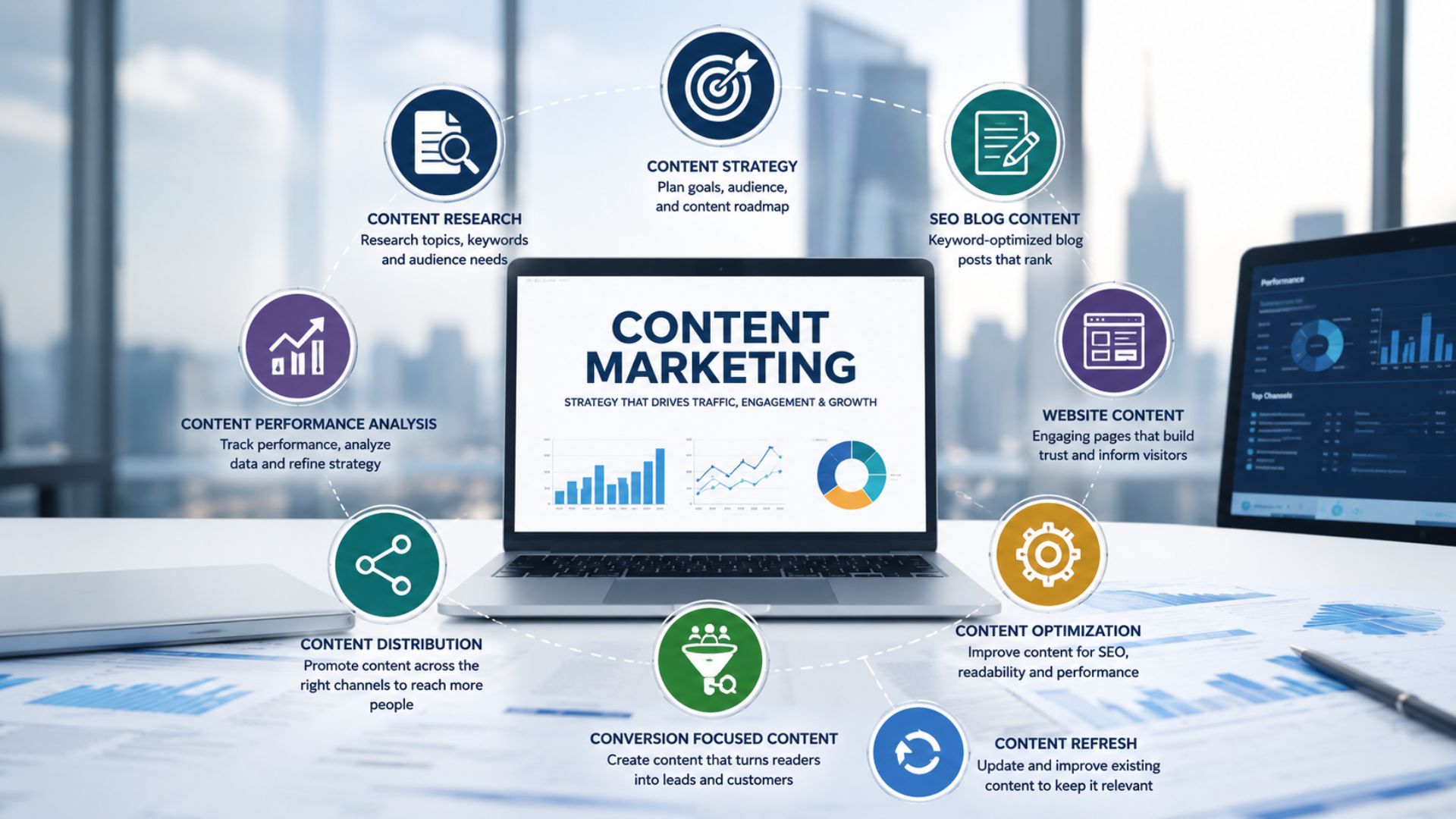
Content Marketing Services Built Around What People Actually Search For
We write content that answers the questions your customers are typing into Google, or asking ChatGPT and other AI tools. It’s planned around your SEO goals, written to actually be useful, and built to give people a reason to trust your business before they ever pick up the phone.
Every piece of content we produce is built around a business goal first. Rankings and traffic are the outcome, not the starting point.
What Content Marketing Actually Does for a Business
Content marketing involves creating and publishing valuable, informative content such as blog posts, service pages, guides, and product-related material. This attracts the right audience, answers their questions, and brings them closer to making a decision. When executed correctly, it works alongside SEO rather than replacing it: the content provides search engines with material to rank and gives readers a reason to trust the business.
That planning is really three things happening together. Strategy figures out what to write about. SEO makes sure people can actually find it. And the page itself needs to point somewhere, usually a call, a form, or a next step, or the traffic it earns won’t turn into anything.
At DMtechhub, we don’t treat content as a separate item on a checklist. It’s part of how a business gets found and gets trusted. We start with what your audience is searching for, write it in a way that actually helps them, and make sure it’s doing double duty: bringing in the right traffic and giving people a reason to pick you.
Why Content Marketing Matters
Paid ads stop bringing traffic the moment the budget stops. Content, if written correctly, keeps working for a long time after it’s published. A well-researched and well written blog post or service page can continue attracting visitors, answering questions, and generating leads for years with occasional updates.
Here’s what consistent, well-planned content marketing supports over time:
- Organic visibility. Content built around real search terms gives your website more opportunities to appear in search results.
- Brand authority. Businesses that consistently publish useful, accurate and real content are seen as more credible and trustworthy in their industry.
- Customer education. Good content answers questions before a customer has to ask them directly, which shortens the sales conversation.
- Trust. People are more likely to buy from a business that clearly understands their problem and communicates that understanding well.
- Qualified traffic. Content built around specific search intent tends to attract visitors who are actually looking for what you offer, not just casual browsers.
- Lead generation. Informational and decision-stage content can be structured to capture inquiries, not just readership.
- Conversion support. Content doesn’t have to convert on its own. It often works by warming up a visitor before they reach a service page or contact form.
- Long-term growth. Unlike ad spend, published content remains an asset on your website that continues to work.
None of this happens automatically or overnight. Content marketing is a compounding channel: the value builds as more relevant, well-optimized content is added and maintained.
Our Content Marketing Services
Content Strategy
We don’t start writing until we know what the content is supposed to do. Who’s it for, what topics actually matter to your business, where does this piece sit in someone’s decision to buy from you. Once that’s mapped out, every future page has a job to do instead of just existing because the content calendar said Tuesday needed a blog post.
Content Research
We’d rather know than guess. That means looking at what your audience is actually typing into Google, what your competitors are already ranking for, and which topics have real demand behind them versus which ones just sound good in a meeting. This is what tells us what to write, and just as importantly, what not to bother with.
SEO Blog Content
A lot of people find a business for the first time through a blog post, not the homepage. We write posts around the questions people are actually searching, answer them properly, and tie them back into your target keywords and the rest of your site so they’re doing more than one job.
Website Content
Your service pages, landing pages, category pages, and product pages are the ones that actually close the deal. We write these so it’s obvious what you offer, easy for Google to make sense of, and structured so someone reading it knows what to do next, whether that’s calling you or filling out a form.
Content Optimization
Sometimes a page doesn’t need a rewrite, it just needs fixing. Better headings, clearer structure, links that actually make sense, or wording that matches what people are searching for instead of what sounded good internally. We go through existing content and tighten what’s already there.
Content Refresh
Content that was right two years ago isn’t necessarily right now. We go back through older pages, update anything that’s out of date, add to sections that were always a bit thin, and bring them back in line with how people search today.
Conversion-Focused Content
Traffic that doesn’t lead anywhere isn’t worth much. Every page we write has somewhere to send the reader once they’re done, whether that’s a form, a call, a download, or a direct inquiry, so the visit actually turns into something.
Content Distribution
Writing something good is only half the job. We help figure out where it should go beyond your website, email, the right social channels, so it actually reaches people instead of sitting there waiting to be found.
Content Performance Analysis
We keep an eye on what’s ranking, what’s bringing in traffic, and what’s actually converting. That’s not just for a report you’ll skim once. It shapes what we write or fix next.
Our Content Marketing Process
| Step | Process | What We Do | Why It Matters |
|---|---|---|---|
| 01 | Business & Audience Analysis | Understand your business, offerings, and target customer | Content built for the wrong audience won’t convert, regardless of quality |
| 02 | Competitor & Market Research | Review what competitors are publishing and ranking for | Reveals content gaps and opportunities specific to your market |
| 03 | Keyword & Search Intent Research | Identify the terms your audience searches and what they expect to find | Aligns content with actual demand instead of guesswork |
| 04 | Content Strategy Development | Build a plan connecting topics, funnel stages, and business goals | Gives every piece of content a clear purpose |
| 05 | Content Planning | Organize topics into a structured content calendar | Keeps output consistent and prevents overlap or gaps |
| 06 | Content Creation | Write and design content for the intended audience and format | This is where strategy becomes a usable asset |
| 07 | SEO & On-Page Optimization | Optimize headings, structure, internal links, and metadata | Helps search engines understand and rank the content properly |
| 08 | Publishing & Distribution | Publish content and share it through relevant channels | Gets the content in front of the audience it was built for |
| 09 | Performance Monitoring | Track rankings, traffic, and engagement | Shows what’s working and what needs adjustment |
| 10 | Content Refresh & Continuous Improvement | Update and expand content based on performance data | Keeps content assets relevant and competitive over time |
Content Types We Create
Blog posts
useful for attracting top-of-funnel traffic and answering user questions
Service pages
the pages that convert visitors researching a specific solution
Landing pages
built for campaigns, offers, or specific search terms
Website copy
homepage, about page, and core site messaging
Product descriptions
for e-commerce businesses needing clear, search-friendly product content
Case studies
useful for building trust with businesses evaluating a decision
Guides
longer, in-depth content for readers researching a topic thoroughly
How-to articles
practical, step-based content that answers a specific task
Comparison content
useful when your audience is weighing options before deciding
Industry-specific content
content written around the terminology and concerns of your sector
FAQ content
addresses common objections and questions directly
Thought leadership content
positions your business as knowledgeable in its space
Local business content
location-specific pages for businesses serving particular areas
SEO content
written specifically to target and rank for defined search terms
Conversion-focused content
built with a clear action or next step in mind
Content Marketing for SEO
A lot of people treat content and SEO like two separate jobs that just happen to live on the same website. They’re not. Content is what SEO sits on top of. No content, nothing to rank.
When we’re writing for a client, this is roughly what’s happening behind the page:
- Checking what people are actually typing into Google, not what sounds good in a meeting
- Building a proper page for a big topic, then linking out to the smaller related questions instead of cramming everything into one post
- Linking pages together the way a reader would actually click through, which Google happens to read the same way
- Cleaning up headings and titles so a page makes sense at a glance
None of that is complicated. It’s mostly just paying attention to structure and search demand instead of writing on instinct.
Older content gets checked every so often too. A page that was accurate two years ago can quietly stop matching what people search for now, or just start looking dated next to competitors who’ve kept theirs updated.
This still leaves technical SEO out of it, on purpose. Site speed, indexing, crawl errors, none of that is content’s job. Content just makes sure there’s something worth ranking in the first place. The two run alongside each other.
Content Marketing for AI Search
Search has expanded beyond the traditional list of blue links. Google AI Overviews, Google AI Mode, ChatGPT, Perplexity, and similar tools now pull directly from web content to generate answers. Getting cited or referenced by these systems isn’t something any agency can guarantee, but there are practical steps that improve the odds.
Content that tends to perform well across AI-powered search shares a few traits:
- Clear, direct structure, with questions answered plainly rather than buried in unnecessary preamble
- Comprehensive topic coverage, so the content answers related questions a reader might have, not just the primary one
- Entity and contextual relevance, meaning the content clearly connects to the right industry, location, and subject matter
- First-hand expertise, information that reflects real understanding of the topic rather than surface-level summarizing
- Trust signals, such as clear authorship, accurate information, and a credible, well-maintained website
- Search intent satisfaction, where the content genuinely resolves what the searcher was trying to find out
We build content with these principles in mind: well-structured, genuinely informative, and specific enough to stand out from generic summaries. What we don’t do is promise guaranteed placement in AI-generated answers. No one controls how these systems select or summarize sources, and any agency claiming otherwise isn’t being straightforward with you.
Why Choose DMtechhub
SEO and content work together. We don’t treat content writing and SEO as separate services handled by disconnected teams. They’re planned together from the start.
Search-intent-driven strategy. Every piece of content is built around what your audience is actually searching for, not just what sounds good.
Business-focused content. Content is written to support your actual goals, leads, sales, visibility, not just to fill a content calendar.
Human-readable writing. Content is written for the person reading it first, and structured for search engines second.
Conversion-focused approach. We build a clear next step into content rather than leaving visitors to figure out what to do next.
Ongoing optimization. We treat content as something to maintain and improve, not something to publish once and forget.
Data-informed decisions. Content direction is shaped by performance data, not guesswork.
Transparent reporting. You’ll know what’s been done, what’s performing, and what’s planned next.
Customized strategy. Your content plan is built around your business and industry, not a generic template applied to every client.