
Meta Advertising Services
Running and managing meta ads campaigns sounds easy but it’s not that easy in reality. It requires proper advertising strategy,understanding algorithms and campaign optimization.
That’s where our role started.
Our Meta advertising services are designed in such a manner that the businesses not only achieve real growth but also get actual inquiries, sales, engagement and leads without wasting your budget.
Why meta ads
Meta ads are paid digital advertisements run across different meta platforms like Facebook, Instagram, messenger and the audience network. They are managed with the help of meta ads manager, a platform used to create, manage and analyze different meta campaigns. These ads help businesses promote their products, services, website reach, brand awareness to specific audiences
Meta ads appear in
- Facebook news feed and stories
- Instagram feed, reels and stories
- Messenger and the audience networK
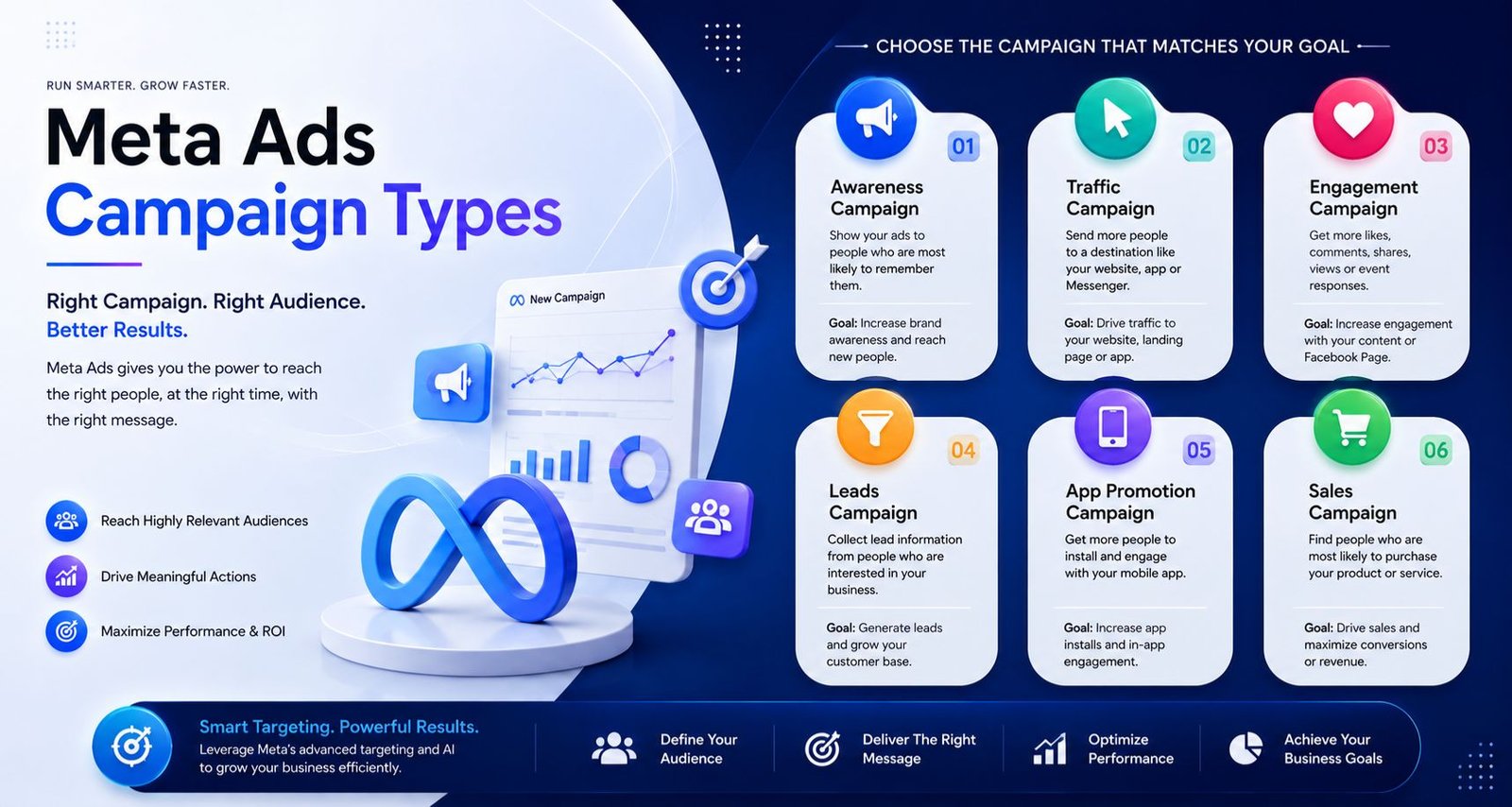
Our Meta Ads Campaign Services
Brand Awareness Campaigns
These campaigns are designed to increase your brand awareness to the people who are interested in your business.
Traffic Campaigns
The traffic campaigns are created to drive users from facebook, instagram, whatsapp to a specific destination such as website, app etc by targeting people most likely to engage.
Engagement Ads
The engagement campaigns are designed to get more interactions such as post likes, shares, comments, video views and it is best for building brand awareness and increasing credibility through social proof.
Leads Campaigns
The lead campaign is designed to collect potential customer information using instant forms within the apps, messenger chats.
App Promotion Campaigns
App promotion campaigns are specifically created to get more app installs and encourage users to take action within the app.
Sales Campaigns
These campaigns are designed on meta to generate real business growth such as product purchases, bookings and enquiries.
How meta ads actually work
Meta ads work on 3-tiered structure including campaign level, ad set level and ads. Advertisers define the objective such as generating sales and inquiries, driving website traffic and brand awareness, budget and target audience while Meta ads algorithm optimizes ad delivery across facebook and instagram to find the users most likely to convert.
When users scroll through their facebook feed and watch instagram reels, there is an auction running behind the scenes. Advertisers bid to capture the user’s attention and meta determines the winner based on the 3 factors such as how much are you willing to pay, how relevant your ad is for that specific person and how likely they will take action on it.
This is the reason why two businesses spending the same budget can achieve completely different results. The business with better targeting , more creative graphics and having correctly set up pixel code almost always wins even if it is bidding less per click.
The tracking code installed on your website tells meta what happens when anyone clicks on your ad. Did they add something to the cart ? Did they fill the inquiry form ? Did they actually purchase anything from the website? Without the tracking code, the meta algorithm is guessing who to show your ads to ?. With it, meta learns from every conversion and gets better at finding similar people.
Meta Ads vs Google Ads: Which One Do You Need?
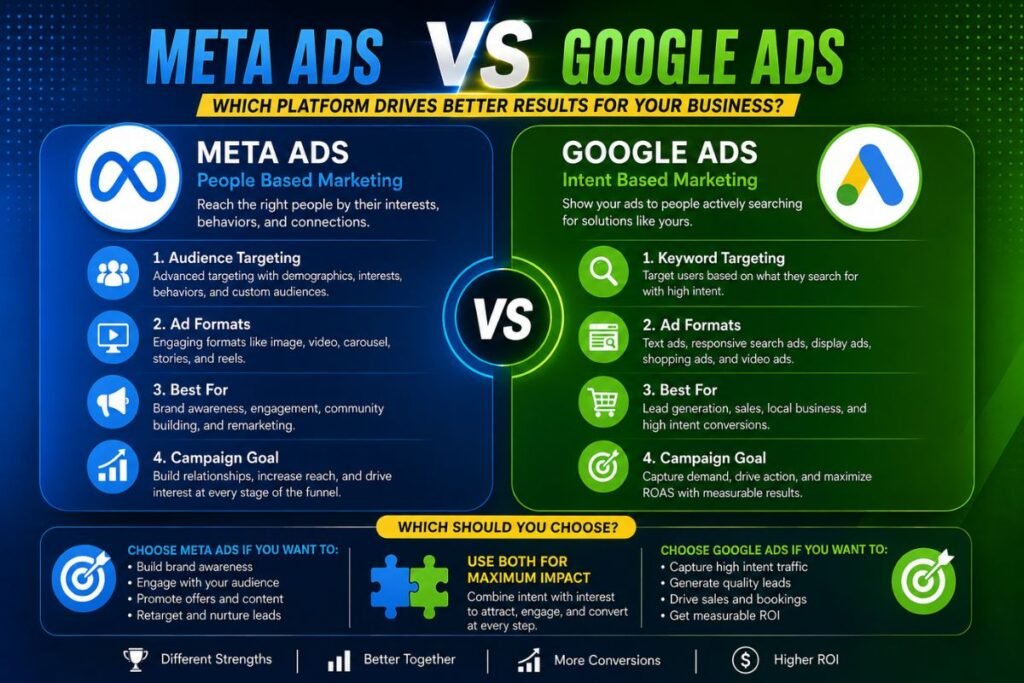
Business owners often confuse this all the time and the reality is both the platforms have different working algorithms.
Google ads show your ads to the people who are already looking for what you sell or what services you are offering. If someone types in google “best skin clinic near me”, they have decided that they need to consult a dermatologist. Google just produces the results before you go to the skin clinic.
Meta ads work in a different way. Nobody logs into Instagram planning to buy a new mattress or book a consultation that day. What Meta does well is put your business in front of the right people before they start looking, based on their age, location, interests and the kind of pages and posts they engage with. It creates demand instead of just catching it.
Most businesses get the results using both meta ads and Google ads. Meta ads spread awareness and get your brand familiar with the people, then Google Ads is there to catch them once they’re ready to buy. If you can only run one right now, think about whether people already search for a business like yours by name. If they do, start with Google. If they don’t know you exist yet, Meta is the better starting point.
Meta Ads Targeting Options Explained
Meta ads targeting options have changed significantly over the past few years, and it’s important to understand how they actually work today rather than how they used to work.
Advantage + Audience - the default now
For most of the campaign goals, meta now runs on something called advantage + audience targeting feature. It is an AI-powered targeting feature that automates the process of finding your ideal customers.Instead of you manually picking every demographic and interest, you give Meta some inputs, like age range, location or an existing custom audience, and the AI treats these as suggestions rather than strict rules. If it spots someone outside your inputs who’s likely to convert, it will still show them your ad. Location and minimum age are really the only hard limits left. Everything else is more of a guide for the algorithm to work with.
This shift happened because Meta’s AI, fed with enough conversion data, is far better at finding buyers than most humans who used to work manually combining various interests. That said, it only works well once your account has a decent amount of conversion history behind it, so newer accounts still need patience here.
Core audiences
This is the traditional way of setting up an audience. You pick the age range, gender, location, language, job title, relationship status, whatever fits, plus interests like fitness, travel or shopping. Meta now treats most of this as a suggestion instead of a strict rule, but don’t skip it just because it’s not binding anymore. It’s still the starting point that points the algorithm in the right direction, and a badly set up core audience will slow down how fast Advantage+ figures out who to actually target.
Custom audiences
Custom Audiences are created using your own data such as people who have visited your website, existing customers, or those who have interacted with your Facebook or Instagram pages. They drive strong conversions because these audiences are already familiar with your brand, and they are typically among the most powerful signals that can be used with Advantage+.
Lookalike Audiences
A ‘Lookalike audience’ is a Meta feature that helps you find new people who share characteristics with your existing customers or website visitors. It is an effective way to expand your reach once your account has gathered enough data to build a model. It also plays a role in ‘Advantage+’ campaigns where, rather than being a separate audience you manage yourself, it serves as one of the signals the AI takes into account.
Our Meta Ads Process
This is roughly how we work with every account, though the details shift depending on the business.
- Getting to know your business first
We don’t open Ads Manager on day one. We spend time understanding your business, your customers, what your competitors are doing, and what you’ve already tried that worked or didn’t. - Setting up tracking properly
This means installing or auditing the Meta pixel and Conversions API, checking your domain verification, and confirming every conversion event is firing correctly. Most underperforming ad accounts we take over have something broken here, so we treat this as non negotiable before spending a rupee. - Planning the campaigns and the creative
We build the campaign structure around what you actually want, leads, sales, app installs or brand awareness, and put together creative made for how people scroll through Instagram and Facebook, not how they’d read a brochure. - Launching and watching closely
Every campaign begins with a testing mindset. We closely monitor performance during the initial weeks to quickly identify issues such as a slow-loading landing page, underperforming ads, or an audience that is too broad or overlaps with another. - Optimising and scaling what works
Once we can see what’s performing, we put more budget behind the winning ad sets and creatives and pull back on the ones that aren’t pulling their weight. Scaling happens gradually so we don’t throw off what the algorithm has already learned. - Reporting that actually means something
You will receive reports based on metrics that matter to your business such as cost per lead, cost per purchase, and return on ad spend rather than metrics like reach or impressions, which may look impressive but offer little real insight.